
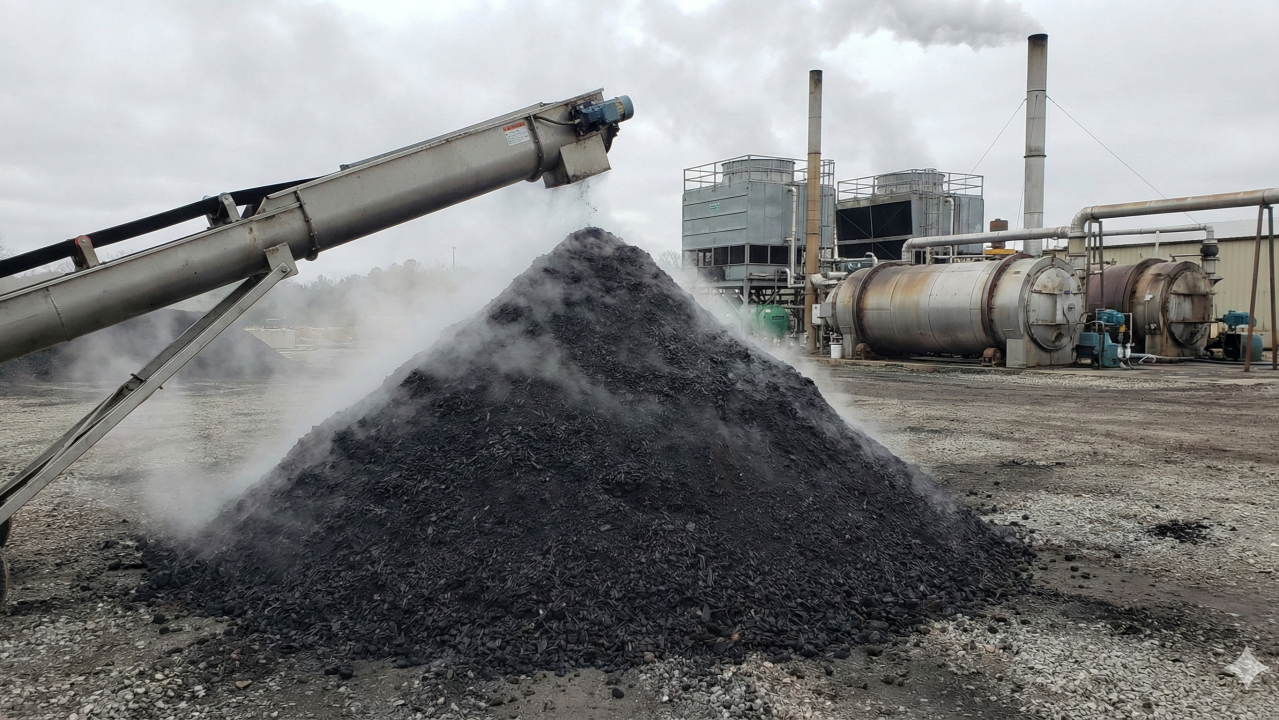
 Biochar is increasingly discussed as a climate solution, a soil amendment, and a tool for carbon sequestration. The commercial conversation is growing. What is growing more slowly is awareness of a material hazard that accompanies it: biochar can self-ignite. During storage. During transport. Sometimes well after it has left the production facility.
This is not a theoretical risk. It has a regulatory history, a documented incident record, and—as of 1 January 2026—a new set of mandatory international requirements that many producers and logistics partners may not yet have adapted to.
The Mechanism
Biochar is produced through pyrolysis: the thermal decomposition of organic material in low or absent oxygen. What remains is a carbon-rich, highly porous solid. That porosity is the source of its agronomic value, i.e., high surface area, strong adsorption capacity, favorable conditions for microbial colonization. Under the wrong conditions, it is also a liability.
When freshly produced biochar is exposed to oxygen, it undergoes exothermic surface oxidation. Heat is generated internally. Under normal conditions, with adequate airflow and sufficient cooling time, that heat dissipates without consequence. That said, when material is densely packed, inadequately cooled, or sealed before it has stabilized, heat accumulates. What begins as mild warming can progress to thermal runaway.
Water introduces a further variable. Wetting of biochar that has not fully stabilized is itself an exothermic process. Material exposed to rain before packaging, or that absorbs humidity during storage in tropical environments, can re-enter a self-heating cycle that is invisible from the outside and difficult to interrupt once a container is sealed and loaded.
A surface temperature reading before loading tells only part of the story. The thermal mass of a tonne-bag of biochar means the core can remain significantly hotter than the surface for days. That discrepancy is where the danger lives.
What Has Happened with Analogous Materials
Biochar shares its fundamental chemistry with charcoal: both are carbon-rich solids produced by pyrolysis of organic matter, both are classified by the International Maritime Dangerous Goods Code under the same UN number, and both carry the same self-heating risk profile. The incident record for charcoal at sea is instructive.
On 3 January 2019, a fire broke out on the container ship Yantian Express while crossing the North Atlantic. The fire burned for three weeks. Of the cargo, 662 containers were damaged and 320 destroyed. Germany’s Federal Bureau of Maritime Casualty Investigation (BSU) concluded that the most likely cause was self-ignition of coconut charcoal that had been misdeclared in shipping documents.
The BSU’s earlier investigation—covering fires on the MSC Katrina (2015) and the Ludwigshafen Express (2016)—documented incidents in which charcoal cargo originating from Southeast Asia caught fire at sea. In both cases, the charcoal had passed the standard UN N.4 self-heating test and was not classified as dangerous goods. The BSU’s conclusion was that the test alone is insufficient: it does not adequately account for the volume-dependent behavior of charcoal in large-format containers.
Between 2015 and 2022, at least 68 container fires were reported as directly linked to charcoal cargo. This data has driven the massive regulatory shift we are seeing today.
Where Biochar Sits in the Regulatory Framework—and What Has Changed
The IMDG Code classifies charcoal under UN 1361: carbon of animal or vegetable origin, Class 4.2, liable to spontaneous combustion. Biochar falls within the same chemical family.
Until recently, exemption pathways existed. Under Special Provisions 925 and 223 of earlier IMDG amendments, shippers could demonstrate through laboratory testing that their material did not meet the self-heating threshold and ship it as non-dangerous goods. Those questions have now been answered at the regulatory level.
IMDG Code Amendment 42-24, which entered mandatory force on 1 January 2026, introduces Special Provision 978 specifically for UN 1361 carbon materials. The “test exemption” route effectively no longer applies as it once did. Under SP 978, producers must now adhere to rigorous, documented stabilization protocols and specific packaging conditions before a cargo can be accepted for transport. The documentation—covering production dates, packing timelines, and core temperature verification—must accompany every shipment and is now a mandatory requirement for shipping lines, freight forwarders, and marine insurers.
Hapag-Lloyd and the Britannia P&I Club have already issued advisories on these requirements. These are not signals of anticipated change. The change is already in force.
Why the Shipping Window is the Critical Interval
A production facility allows for observation. A shipping container crossing a tropical sea route for two or three weeks does not. Internal container temperatures can significantly exceed ambient air temperature, particularly for units stowed on deck in direct sunlight. Biochar loaded at marginal safety enters that environment and stays there for the duration of the voyage without the possibility of intervention.
The Yantian Express incident illustrates the scale of what can follow. The cargo that most likely started it weighed a fraction of what was destroyed.
What This Means for Producers
Biochar is not shisha charcoal. Its risk profile depends on feedstock, pyrolysis temperature, and post-production handling. However, without validated thermal documentation and adherence to the new stabilization mandates, that distinction is invisible to everyone downstream—the freight forwarder, the shipping line, the insurer, and the port receiving the container.
SP 978 now codifies what responsible handling always required: a documented stabilization period and a verifiable temperature record. For producers who have not yet adapted their operations and documentation to the new amendment, the window to do so has already closed.
The fire hazard in biochar is real, it is characterizable, and it is manageable. The regulatory framework to manage it now exists. The question is whether the industry catches up to it before the incident record for biochar begins to look like the one for charcoal.