
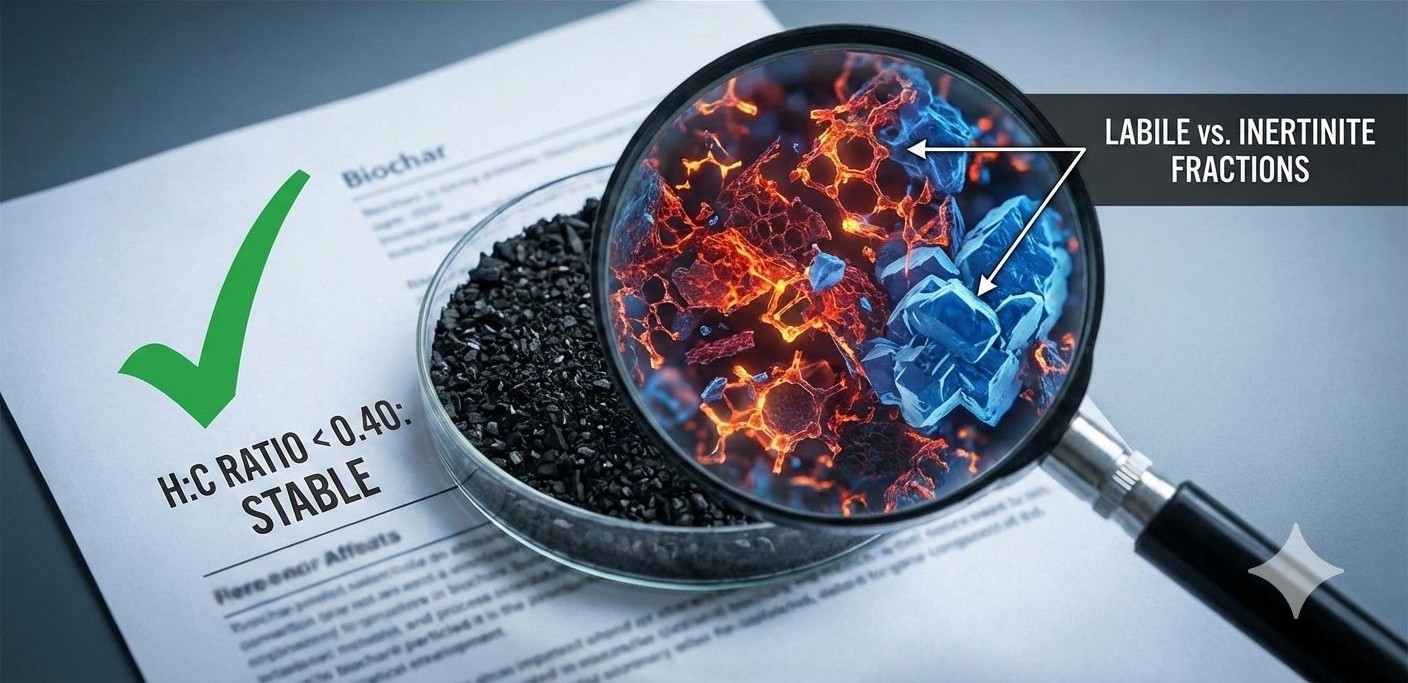
In 2025, researchers analyzed two biochar samples that the Global Biochar C-Sink Standard would classify as semi-persistent — carbon likely to degrade within 1,000 years, a weaker credit, a penalized producer.
Petrographic analysis found both samples were 98–99% highly stable inertinite carbon. The standard method had simply missed it.
That finding, from Petersen and Sanei (GCB Bioenergy, May 2025), cuts in both directions. If the H:C molar ratio — the industry’s default measure of permanence — can underestimate stability, it can also overestimate it. Materials that pass the threshold can carry incompletely carbonized fractions that will degrade on timescales that matter to a 100-year carbon accounting horizon. The ratio doesn’t see that either. The credit gets issued anyway.
This matters now. Biochar accounted for 86% of all durable carbon removal credits delivered globally in 2024. Microsoft, Google, JPMorgan Chase, and Swiss Re are buying at scale. The EU’s Carbon Removals and Carbon Farming Regulation came into force in December 2024. Puro.earth updated its methodology in 2025 to require several-century durability guarantees. The documentation bar is rising.
Buyers at this level have climate science teams. At some point the question shifts from “do you have an H:C ratio below 0.40” to “how do you know, and what is your evidence.”
Those are different questions. The first has a cheap answer.
Producers who cannot navigate the distance between the two may find themselves holding assets the market no longer recognizes.