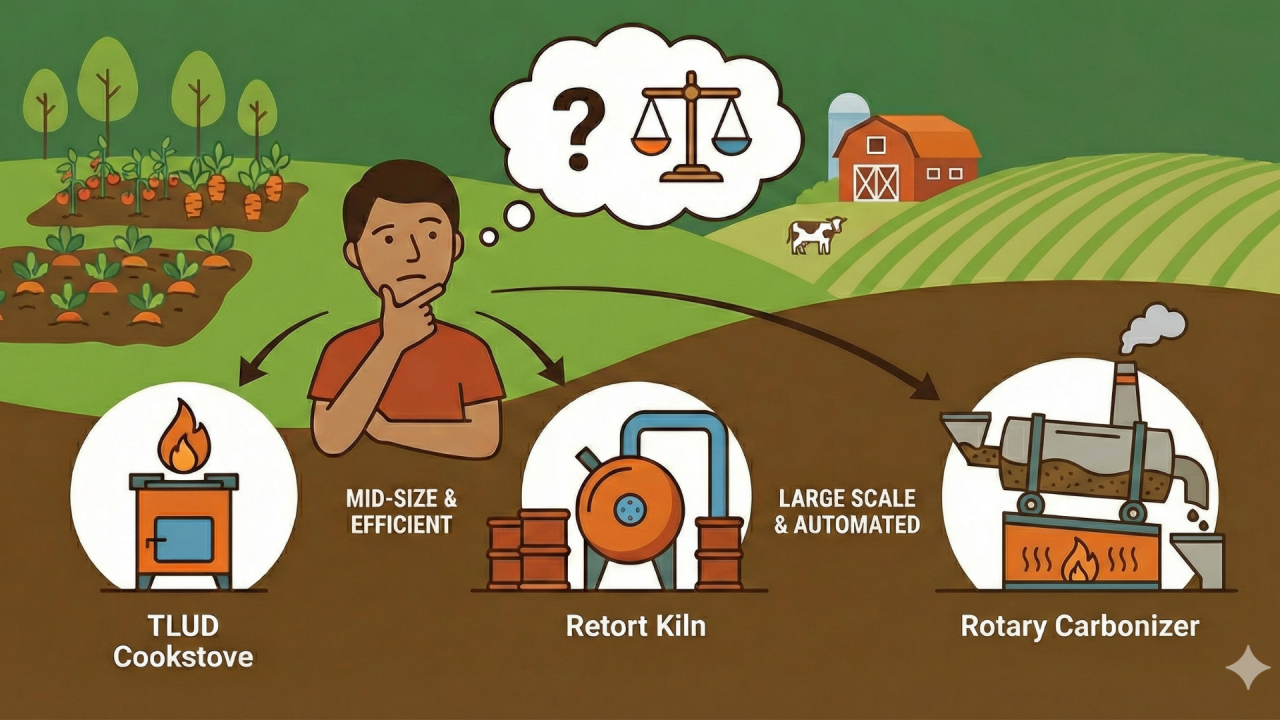
 Most failed biochar projects don’t fail because of chemistry. They fail because someone bought a reactor that couldn’t handle their feedstock.
This sounds obvious. It isn’t—because the information needed to make good matching decisions is scattered across proprietary experience, unpublished trial-and-error, and a surprisingly thin academic literature.
A 2023 comparative review in the Journal of Analytical and Applied Pyrolysis examined 21 unique rotary kilns and 58 unique auger reactors from a decade of research. The authors observed that “literature comparing the influence of the reactor type on biochar properties was very scarce.”
We have extensive studies on how temperature affects carbon structure, how heating rates influence surface chemistry, how residence time shapes stability. We have far less on how the same feedstock behaves differently in different reactor configurations—and comparatively little, at accessible scale, on how different feedstocks behave in the same reactor.
The research that does exist reveals a telling gap: studies most commonly use feedstock ground to below 5mm, while the stated optimal range for auger reactors is 5–50mm. Researchers optimize for experimental control. Production operates under different constraints.
Where matching goes wrong
Three categories of mismatch account for many operational difficulties.
Moisture behavior. Pre-treatment and drying are standard practice, but even after careful preparation, feedstock from the same source doesn’t always behave uniformly. Moisture distribution within particles, residual variation between batches, interaction with other properties—these can persist through standardization in ways that affect pressure dynamics, heat demand, and residence time. Designing processes that account for variation that survives pre-treatment is where operational reality diverges from what the literature discusses.
Ash interaction. The literature reports ash content as a percentage. What often matters more operationally is ash composition. High-silica agricultural residues can cause slagging and fouling that doesn’t appear in bench-scale testing. The conditions that produce slagging—sustained temperature, accumulation over time, interaction with specific reactor surfaces—are difficult to replicate in a laboratory setting.
Bulk density shifts. Feedstock enters a reactor at one bulk density and exits as char at another. In a screw reactor, this affects auger torque and material flow. In a rotary kiln, it affects bed behavior and residence time distribution. These mechanical realities don’t surface in thermochemical analysis.
The questions that matter
Before committing to a reactor, the questions worth asking aren’t about peak temperature or rated capacity. They’re about behavior under real conditions.
How does this reactor manage pressure when feedstock properties vary between batches? What happens to material flow when bulk density drops mid-process? What is the actual residence time distribution at target throughput—not the mean, but the spread? How does this design handle high-ash feedstock over extended operation? What difficulties has this configuration encountered, and what design changes resulted?
These aren’t questions most equipment specifications address. They’re also not questions the academic literature tends to answer.
Why this information is hard to find
The knowledge exists. Manufacturers learn through iteration which geometries hold up and which don’t. Operators learn through experience how to adjust for variation, how to recognize early signs of fouling, how to manage the distance between specification and reality.
But this knowledge stays fragmented. Manufacturers treat operational insight as proprietary. Academic incentives reward findings about biochar properties, not guidance on reactor selection. There’s no established forum for discussing operational difficulties openly.
The result: entrants to the field often learn the same lessons others have already learned. The gap between what’s promised and what’s achievable stays wider than it needs to be.
What this means
Good feedstock-reactor matching is possible. It requires asking questions that equipment specifications don’t address and that the academic literature hasn’t studied.
The most useful information often comes from operators who have run similar feedstocks in similar configurations and are willing to discuss what they learned along the way. Those conversations are harder to find than specification sheets. They’re also worth more.
Reference:
Moser et al., “Screw reactors and rotary kilns in biochar production—A comparative review,” Journal of Analytical and Applied Pyrolysis 174 (2023).