
In Wolowea Village, on the island of Flores in eastern Indonesia, a women’s group called Kelompok Delima wanted to know if biochar works. Bhetochar met the enthusiastic group of moms last year. We held a workshop with them. They learned how to operate our retort kiln, and we worked with them to set up a demo plot.
They did not commission a study. They ran one.
Four raised beds. Four treatments. Chili seedlings planted January 20. Two observers from the group recorded leaf count, leaf width, plant height, and soil condition.
Plain soil produced 7 leaves and 17 cm of height. The soil stayed wet and compacted. The plants survived. They did not thrive.
Soil with 120 kg of cow manure did better. 20 leaves. 40 cm. The soil turned loose. This is the standard organic input that farmers in Nagekeo already use.
Then the finding that changes the economics.
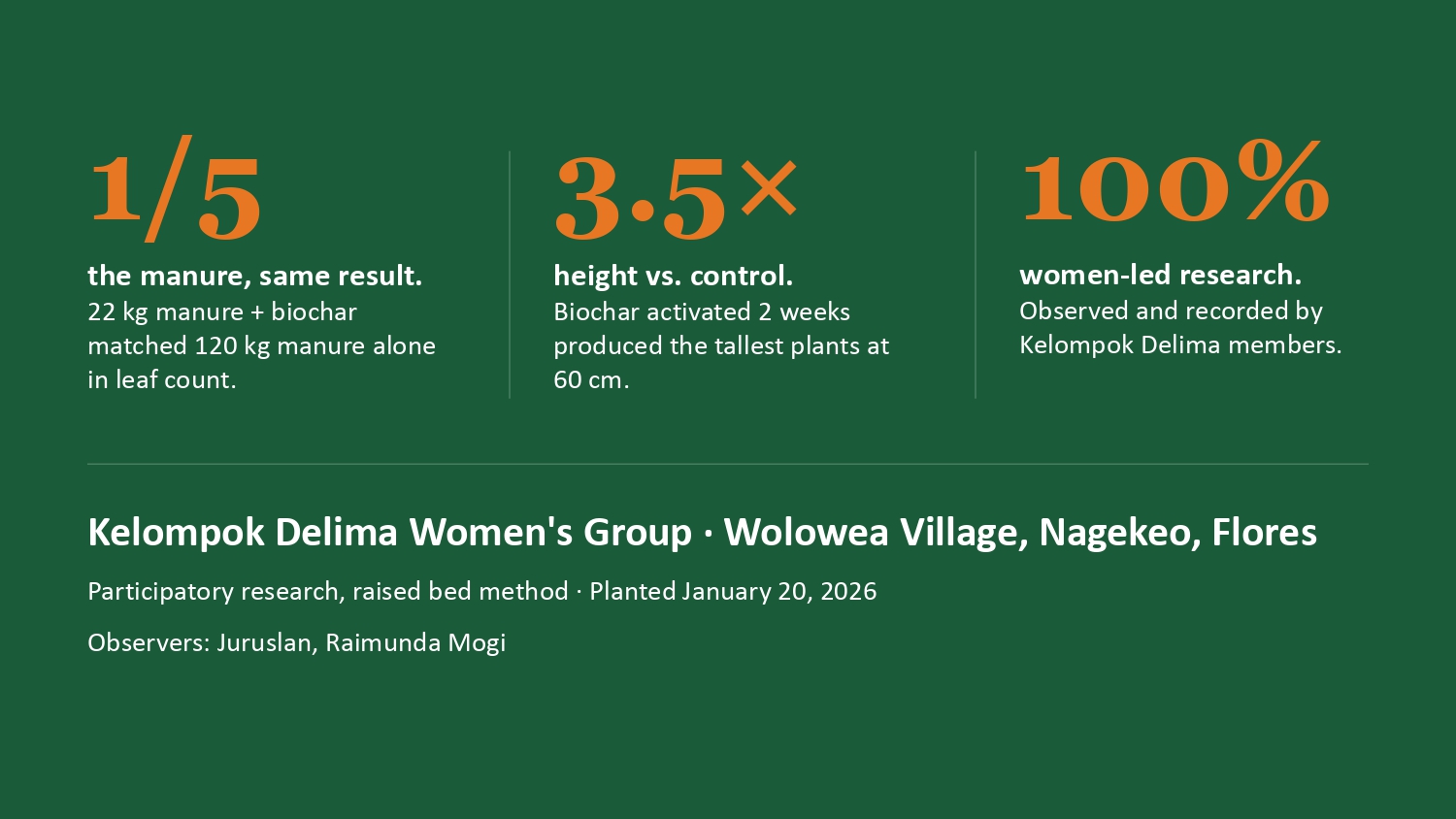
Soil with only 22 kg of manure plus 7.5 kg of biochar, activated for two days, produced 30 leaves and 37 cm of height. Less than one fifth of the manure. Fifty percent more leaves. Nearly the same height. The soil was loose.
The best treatment used biochar activated for two weeks. 30 leaves. 60 cm. Three and a half times the height of the control.
This is not a peer-reviewed trial. There are no replicates. The manure doses are not uniform across treatments. The date of the second observation was not recorded. The women who ran this trial know its limits.
But the data says something that matters.
It says that biochar compensates for scarce organic fertilizer. It says that activation time affects performance. It says that compacted clay soil, the kind that covers much of Nagekeo, becomes workable when biochar is added.
And it says that women farmers, given simple tools and a clear question, generate agronomic evidence that holds up to scrutiny.
Kelompok Delima is preparing to present these results to their district planning agency. The demo plot is still growing. They are waiting for harvest data. The strongest evidence is still ahead of them.
Sometimes the most useful data does not come from a laboratory. It comes from a raised bed in a village, tended by women who needed to know.