
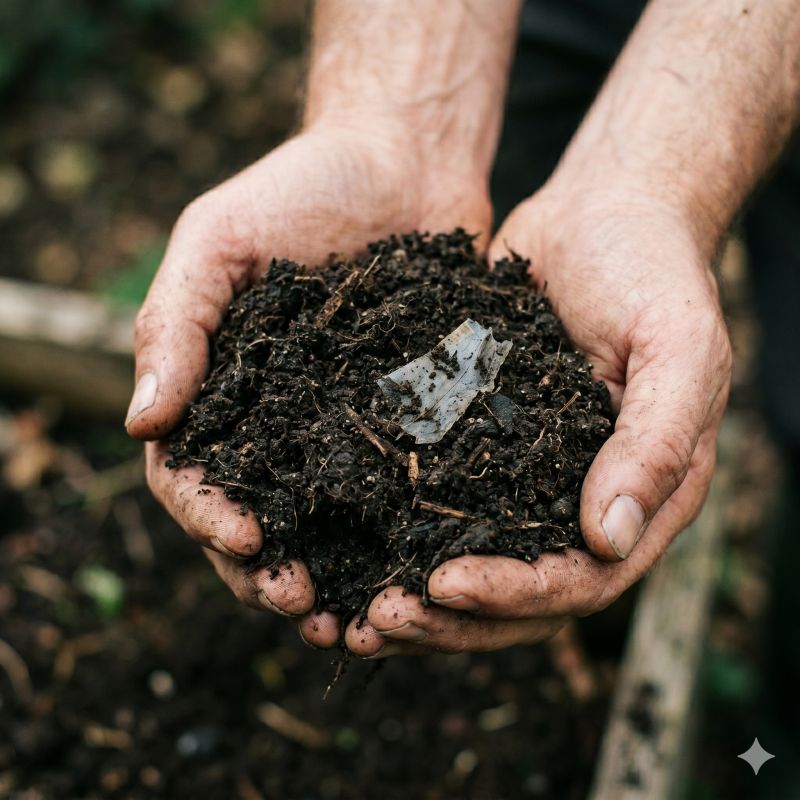
Every plan to fix organic waste ends at the same word. Compost. Divert the food scraps, compost them, return them to the soil. The loop closes. The word does a lot of quiet work in those sentences, and most of it is unexamined
Here is what “compost” can hide.
- Carbon-to-nitrogen ratio.
A finished compost has a carbon-to-nitrogen ratio. If that ratio is too high, the material is immature. Spread it on a field and soil microbes will pull nitrogen out of the soil to finish the decomposition the pile never did. The crop goes hungry. The farmer applied a soil amendment and got a soil deficit. - Maturity.
A finished compost has a maturity. There are tests for this. Solvita is one. They exist because “looks like soil, smells like earth” is not a measurement, and immature compost looks and smells fine. - Salinity.
Compost made from food waste can carry a salt load. Hospitality waste especially, since cooked food is salted food. Apply it once and nothing happens. Apply it every season, on the same ground, and sodium accumulates. Garden and green waste don’t have this problem, which is the point: the feedstock decides. - Contamination.
Field separation is never total. Plastic rides through, then shreds during processing into fragments the finished compost carries into the soil and does not give back
I should be even-handed. None of this is unique to compost. “Biochar” is no more uniform a word. A char made at the wrong temperature, from the wrong feedstock, can do as little for a soil as an immature compost can. I produce biochar. I hold my own material to the same question I am about to ask of compost. The standard has to run both ways or it is not a standard.
None of this is an argument against compost. Good compost is one of the most useful things a degraded soil can receive. I work with it.
It is an argument against the word. The useful question isn’t whether to compost. It’s compost of what specification. C:N ratio, maturity, salinity, contamination. A plan that can answer those is a real plan. A plan that hasn’t reached those questions yet isn’t wrong. It just isn’t finished.
Waste diversion is real progress. But the soil does not receive diversion. It receives a material. And a material has properties, or it has problems.