
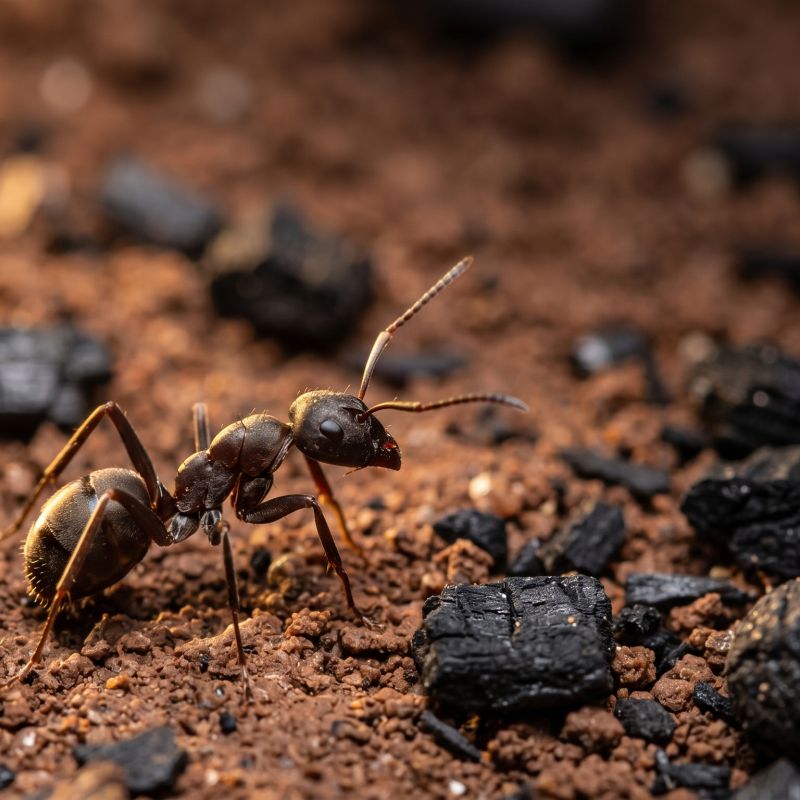
A new paper in the journal Biochar (Liu et al., 2026) reports that rice straw biochar enhances ant colony function at 2.5 to 5 percent application, and collapses it at 10 percent. Survival drops. Foraging slows.
The chemistry that ants use to recognize each other gets disrupted by the shift in soil pH and the persistent free radicals the biochar carries.
The ants are not alone. A 2024 review in Science of the Total Environment (Wang et al.) examines the earthworm literature and identifies feedstock, pyrolysis temperature, and dose as the factors that determine whether biochar’s effect on earthworms is positive or negative.
A global meta-analysis the same year, in the same journal (Zhao et al., 2024), finds that biochar improves soil carbon, nitrogen, and bacterial richness at low to moderate doses, but shifts bacterial community structure significantly above 2 percent, with specific fungal and bacterial phyla declining.
Different organisms. Different methods. The same finding: biochar’s effect on soil ecology is dose-dependent, and the carbon protocols do not ask.
Each of these papers tested bounded systems. None of them claim biochar is categorically harmful. But what they show, taken together, is the question the CDR field has been allowed to skip at scale.
The major biochar carbon protocols all require product-side testing. Heavy metals. PAHs. Dioxins. H:Corg ratio. What none of them require is a soil ecology baseline at the application site, or monitoring of that site after the biochar goes in. The carbon math gets done. The soil is treated as a passive vault.
It is not.
Soil is an ecosystem. Ants are part of it. So are the microbes, the fungi, the invertebrates whose work makes the soil hold water and cycle nutrients in the first place.
A protocol that credits carbon while ignoring the living system that stores it is not a climate solution. It is a transfer of risk from the atmosphere to the ground, with the ground asked to absorb it silently.
Biochar can restore soil. The same product, in the wrong dose, on the wrong soil, can cause harm that no carbon registry currently asks anyone to detect.
Pre-screening is not optional. Post-sequestration monitoring is not optional. They are the minimum the ethics of this work requires.
The alternative is negligence dressed as climate action.
Liu et al. https://lnkd.in/g2SQJr8Y
Wang et al. https://lnkd.in/gTQUbtYs
Zhao et al. https://lnkd.in/g7RtKB4Q